Founder guides
The Best Product Hunt Alternatives for Launching in 2026
Compare the best Product Hunt alternatives for startups by audience, launch format, pricing, listing permanence, and product fit.
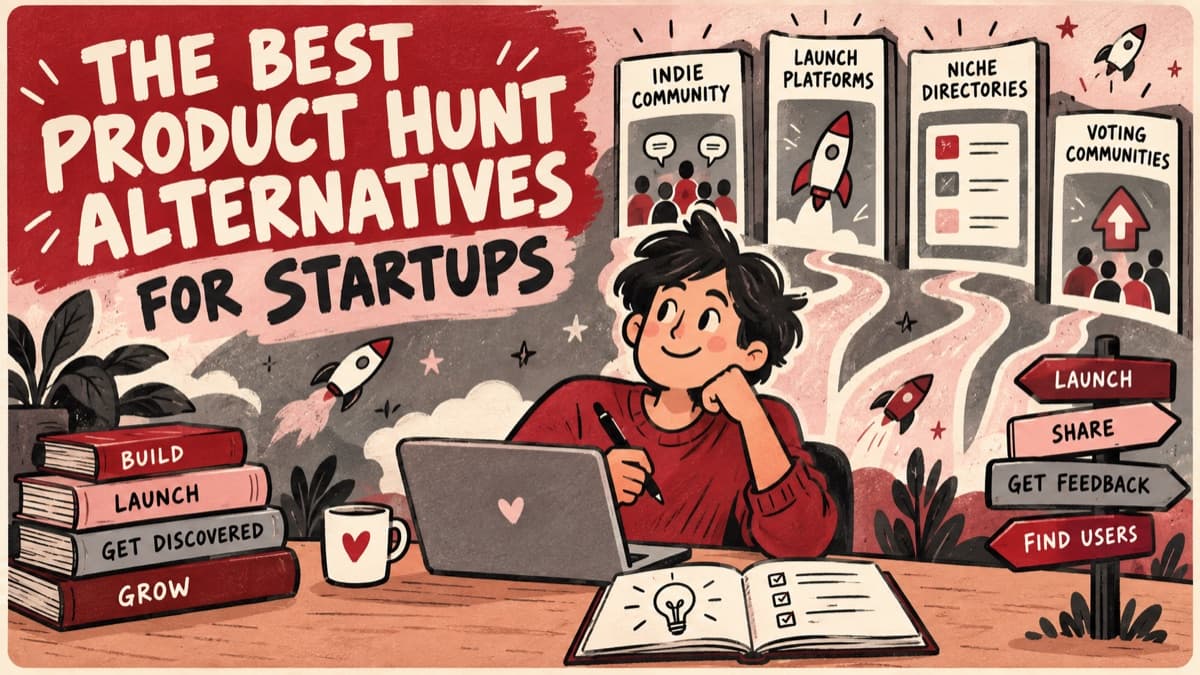
The best Product Hunt alternative depends on the launch you need. BetaList is strongest before release, Peerlist Launchpad fits products built for professionals, DevHunt is focused on developer tools, and Hacker News can produce unusually valuable technical feedback. Uneed and MicroLaunch offer calmer product-led discovery, while AlternativeTo is better treated as an evergreen software-discovery channel than a launch-day replacement. Product Hunt still gives a launch a recognizable moment, but narrower communities can produce more relevant feedback and permanent directories can keep working after a leaderboard disappears. Most founders should combine one focused launch platform with one or two durable listings instead of copying the same announcement into dozens of low-quality directories.
Compare Product Hunt alternatives
| Product | Best for | Pricing |
|---|---|---|
| Peerlist Launchpad | Professional and developer-facing products | Free participation; verify current launch rules |
| Uneed | Bootstrapped SaaS and straightforward web products | Free queue with optional paid launch options |
| BetaList | Pre-launch products collecting early adopters | Free submission with paid review options |
| MicroLaunch | Small products that benefit from a longer launch window | Free and paid options are published by the platform |
| DevHunt | Developer tools, APIs, libraries, and infrastructure | Free launch participation |
| Show HN | Interesting technical products with a working demonstration | Free community submission |
| AlternativeTo | Evergreen discovery through comparison searches | Free community listing and contribution model |
| RareWeb | Independent software seeking reviewed, lasting discovery | Free Open Shelf submission; optional paid directory publication after approval |
Pricing was checked against official product pages on September 20, 2026. Prices are in USD unless noted and can change; taxes, annual commitments, usage charges, and regional pricing may apply.
How we selected these products
RareWeb compared each platform using its current public submission flow and documentation. We considered audience fit, free access, launch cadence, review or queue behavior, permanence of the listing, usefulness after launch day, and the amount of community participation required. Traffic and backlink claims that could not be verified from a primary source were not used to determine the order. RareWeb is included with an explicit ownership disclosure and is not automatically ranked first.
Best Product Hunt alternatives for startups
Peerlist Launchpad
Professional and developer-facing products.
Launchpad connects a product launch to a professional profile and an existing builder network. That identity layer can make feedback more useful than anonymous voting, particularly for developer, design, and career products. A launch is attached to a maker's professional profile, giving visitors useful context about who built the product and making technical feedback less anonymous. The audience already includes engineers, designers, and product people, so professional tools can reach evaluators who understand the workflow without a long category explanation.
Plans and pricing
Launching and participating are free. There is no conventional software subscription: the real cost is preparation and community participation. Peerlist publishes launch rules and eligibility details, so founders should verify the current schedule before fixing a campaign date.
Keep in mind
It is most effective when the maker already participates on Peerlist; it is not a passive directory submission.
Uneed
Bootstrapped SaaS and straightforward web products.
Uneed provides a familiar daily product-discovery format with a smaller field than Product Hunt. A permanent product page gives the launch some value after its featured day ends. Each product receives a persistent page rather than disappearing when its featured day ends, giving founders a durable link for future discovery and comparisons. The daily discovery format is familiar enough to require little explanation while the smaller field can make thoughtful positioning more visible than on a crowded general launch board.
Plans and pricing
Uneed maintains a free submission route alongside paid options that can accelerate or enhance a launch. Because queue position and packages can change, compare the currently published options against the value of a fixed launch date before paying.
Keep in mind
Queue times and paid acceleration can affect launch timing, so it should not be the only fixed date in a campaign.
BetaList
Pre-launch products collecting early adopters.
BetaList is useful before a full public release. Its audience expects unfinished startups and early access, making it a better fit for waitlists and validation than for announcing a mature product. Visitors expect early-stage products, private betas, and waitlists, so founders can ask for learning and sign-ups without pretending the product is already mature. The pre-launch context makes it useful for validating positioning and collecting an initial audience before spending the main public launch on a broader community.
Plans and pricing
A standard submission can be made without buying a recurring plan, while paid review or acceleration options may be offered during submission. Treat any payment as a timing purchase, not a promise of acceptance, traffic, or conversions.
Keep in mind
The editorial queue can be slow, and acceptance or a specific publication date is not guaranteed.
MicroLaunch
Small products that benefit from a longer launch window.
MicroLaunch stretches discovery beyond a single day and is explicitly oriented toward small software products. It suits founders seeking feedback and gradual visibility rather than one large traffic event. Its longer leaderboard cycle gives small products more than a few hours to be noticed and reduces the pressure to coordinate every vote on one morning. The community is explicitly interested in small software launches, which can produce more relevant feedback for bootstrapped products than a broad technology audience.
Plans and pricing
The platform publishes free and paid launch paths rather than a recurring SaaS plan. Review the current package, placement period, and included promotion before purchase; paying should support a longer discovery window, not replace founder participation.
Keep in mind
Its audience is smaller than Product Hunt, so expectations should center on relevance and feedback rather than raw reach.
DevHunt
Developer tools, APIs, libraries, and infrastructure.
DevHunt has the clearest audience fit for developer products. Technical visitors are better positioned to evaluate an API, CLI, library, or infrastructure tool than a broad consumer launch audience. The narrow developer audience gives APIs, libraries, CLIs, and infrastructure products a better chance of being judged on technical utility instead of broad consumer appeal. A product can explain integrations, architecture, and developer experience directly, avoiding the simplified pitch often needed on general-purpose launch platforms.
Plans and pricing
Developer-tool launches can be submitted without a paid subscription. The practical investment is a working demo, clear technical documentation, and time to answer implementation questions from an audience likely to inspect the product closely.
Keep in mind
The specialization is a weakness for consumer, lifestyle, and nontechnical business software.
Show HN
Interesting technical products with a working demonstration.
A successful Show HN discussion can deliver detailed scrutiny from engineers and founders. It works best when the maker explains how the product was built and participates openly in the comments. Strong discussions can expose architectural assumptions, onboarding failures, and unexpected use cases faster than a vote-driven launch page with little substantive feedback. The format rewards a candid build story and a working product, allowing technically credible founders to earn attention without purchasing distribution or coordinating votes.
Plans and pricing
Submitting a Show HN post is free and has no paid placement tier. Founders pay with attention: the post needs a usable demonstration, a direct explanation from the maker, and active participation in a technically demanding discussion.
Keep in mind
Results are highly variable, promotional language is poorly received, and there is no guaranteed featured position.
AlternativeTo
Evergreen discovery through comparison searches.
AlternativeTo is not a launch board, but its product-and-alternative structure can keep a tool discoverable when users compare established software. It is a useful companion to a time-bound launch. Users arrive with comparison intent, so a well-positioned listing can be discovered when someone is already looking to replace an established product. The page remains useful after launch week and can accumulate alternatives, likes, and comments that clarify the product's place in a crowded category.
Plans and pricing
Adding and maintaining community software information is free; AlternativeTo is not sold as a launch-day subscription. The value comes from accurate categorization, alternatives, platform support, and community validation over time.
Keep in mind
A listing needs accurate categorization and community validation; it does not create a coordinated launch event.
RareWeb
Independent software seeking reviewed, lasting discovery.
RareWeb combines editorial review with permanent discovery surfaces rather than a daily voting contest. It is operated by the publisher of this guide and is included to make the comparison complete, not as an independent endorsement. Reviewed listings prioritize a clear product description and lasting discovery instead of requiring founders to manufacture a burst of launch-day votes. The Open Shelf and directory serve different stages, giving accepted products a free discovery path while keeping optional publication separate from editorial judgment.
Plans and pricing
The Open Shelf accepts free submissions. A separate paid directory publication may be available only after review, but payment cannot purchase editorial inclusion, a recommendation, or placement in this guide. Current publication terms are shown before checkout.
Keep in mind
RareWeb is newer and has a smaller audience than established launch communities; submission does not guarantee acceptance.
Decision guide
How to choose
- 01
Choose by audience before estimated traffic. A developer API belongs in a technical community; a broad productivity app can use a general launch board; an unreleased product belongs on a pre-launch platform.
- 02
Sequence submissions instead of stacking them on one morning. Start slow editorial queues early, choose one primary launch day, then add permanent discovery listings after the product page and messaging have been improved with feedback.
- 03
Prepare one source-of-truth launch document containing the short description, long description, screenshots, founder bio, pricing, categories, and tracking links. Adapt the story for each community rather than pasting identical promotional copy.
FAQs
Common questions
Show HN is a strong free option for genuinely technical products, while Peerlist Launchpad and DevHunt provide better-defined audiences for professional and developer tools. The best choice depends on product fit, not only cost.